I never thought I‘d see the day when "Googling" something and sifting through links would become passé. But, like many marketers over the last year, I’m seeing a massive shift in how people find brands, products, and answers online.
More and more consumers are getting their answers directly from AI platforms like ChatGPT, and marketers are leveraging generative engine optimization (GEO) tactics to boost brand awareness and get cited by AI answer engines.
Not sure if GEO is worth all the hype? No worries, I rounded up some Generative Engine Optimization statistics to show you how crucial GEO is in modern digital marketing.

Table of Contents
- Why generative engine optimization is so important now
- Generative engine optimization statistics marketing leaders should know
- Frequently Asked Questions about Generative Engine Optimization statistics.
Why generative engine optimization is so important now
Generative engine optimization is crucial to digital marketing now because the way consumers search for products and services has changed significantly over the last few years. When I first entered the digital marketing industry, consumers typically searched for answers by plugging inquiries into search engines like Google.
They'd then browse the top links Google provides until they found the answers they were looking for.
Now, consumers are asking questions to AI systems like ChatGPT, Google AI, and Perplexity, and these systems are providing direct answers rather than links for users to sift through. As a result, many businesses are seeing a drop in website traffic.
Now, to keep up with how people are discovering brands and businesses, marketers must shift from optimizing for SERPs (SEO) to optimizing for AI-powered answer engines; in other words, General Engine Optimization (GEO).
GEO enables making content easily accessible to Large Language Models (LLMs), so it can be summarized and cited in AI-generated answers.
Generative engine optimization statistics marketing leaders should know
Here are some facts I've gathered about the use and importance of generative engine optimization, ranging from user adoption to SERP changes to the most cited content formats.
User Adoption
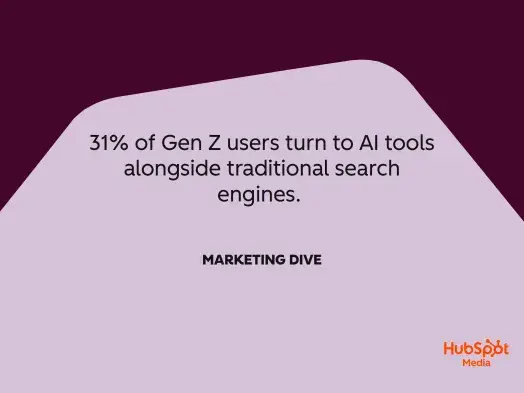
1. 31% of Gen Z users turn to AI tools alongside traditional search engines.
2. 67% of digital marketers say GEO tracking is more complex.
Pro Tip: To simplify this complexity, tools like HubSpot's AEO Grader can help you quickly assess how well your content is optimized for AI answer engines, providing actionable recommendations without the steep learning curve.
3. Early adopters say GEO-ready content is discovered up to 10x faster by generative engines compared to relying on organic SEO alone.
4. Gen AI search visitors are expected to surpass traditional search by 2028.
5. Perplexity processes 780 million search queries a month, up from 230 million in August 2024.
6. According to reports from Averi and DataSlayer, ChatGPT reached 800 million weekly active users as of October 2025, doubling from 400 million in February. According to HubSpot's State of AI Marketing Report, marketers are responding to this surge by rapidly adopting AI-powered tools to stay competitive in this evolving landscape.
SERP Changes
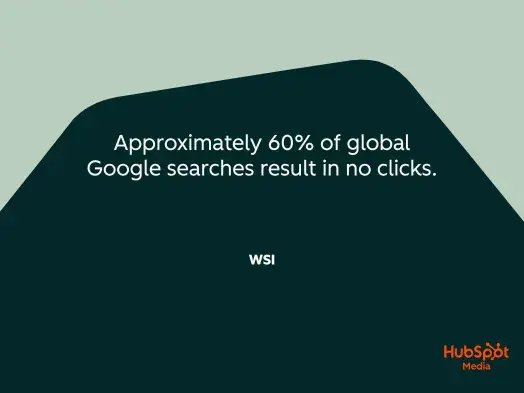
7. Approximately 60% of global Google searches result in no clicks.
8. The September 2025 “num=100” update led to 77% of sites seeing a drop in total impressions in tracking tools.
9. AI Overviews now list an average of 5 sources.
10. In January 2025, 91.3% of queries that triggered an AI Overview were informational. By October, that share was down to 57.1%, and the share of commercial and transactional AIOs
rose.
11. Reddit saw a 450% increase in AI citations from March to June 2025, with the platform now accounting for 21% of Google AI Overview citations.
12. The top 5 domains capture 38% of citations, the top 10 secure 54%, and the top 20 command 66%, making it extremely difficult for smaller publishers, niche sites, and emerging voices to gain AI visibility.
Behavior shifts
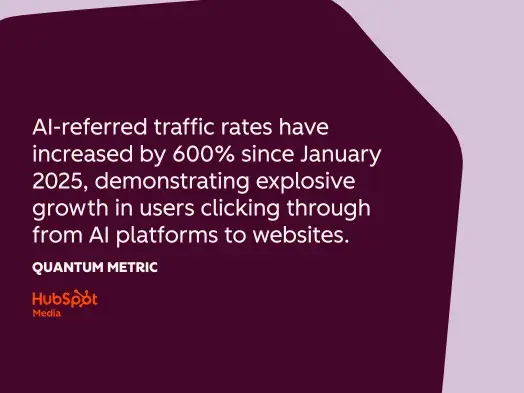
13. AI-referred traffic rates have increased by 600% since January 2025, demonstrating explosive growth in users clicking through from AI platforms to websites.
14. 39% of consumers, and over half of Gen Z, are already using AI for product discovery, with younger demographics leading adoption. HubSpot's State of AI Marketing Report confirms this behavioral shift, showing that forward-thinking marketers are already restructuring their content strategies to meet consumers where they're searching.
16. 83% of users find AI-powered search tools more efficient than traditional engines, indicating strong user satisfaction driving continued adoption.
17. ChatGPT prompt volume jumped nearly 70% from January to June 2025, demonstrating rapid acceleration in AI search adoption.
18. Studies show that when AI summaries were present, users clicked on traditional search links in only 8% of visits—compared to 15% when no AI summaries appeared, representing a 54% drop in click-through rates.
19. 80% of consumers rely on AI-written summaries for at least 40% of their searches, fundamentally changing how people consume information online.
Most Cited Content Formats
20. Video is the single most cited content format across every vertical, with YouTube alone accounting for nearly a quarter of all citations, making it the leading content type for AI citations.
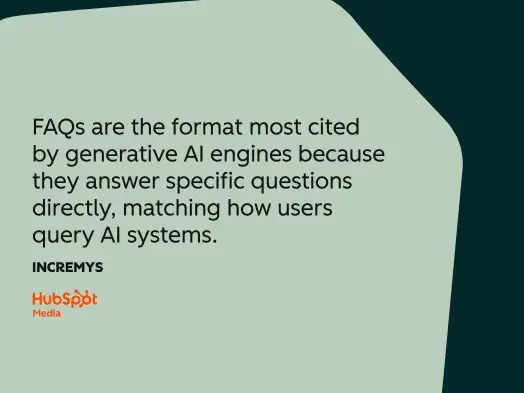
21. FAQs are the format most cited by generative AI engines because they answer specific questions directly, matching how users query AI systems.
22. LLMs are 28-40% more likely to cite content with clear formatting—hierarchical headings, bullet points, numbered lists, and tables, demonstrating the importance of structured presentation. Creating this structured, citation-worthy content at scale is easier with platforms like HubSpot's Content Hub, which helps teams produce, organize, and optimize content with built-in AI assistance while maintaining the quality standards that AI engines prioritize.
23. Listicles achieve a 25% citation rate versus 11% for narrative blog posts and opinion pieces, showing structured formats significantly outperform traditional content.
24. Comparative listicles, how-to guides, and FAQs are the most cited formats across platforms, with answer-first formatting being particularly effective.
Frequently Asked Questions about Generative Engine Optimization statistics.
How fast can we see impact from GEO?
Unlike traditional SEO, which can take 6-12 months, AI visibility improvements can appear within weeks—especially on platforms like Perplexity that conduct real-time web searches. Structural optimizations, such as schema and formatting, can impact citations within 30-60 days, while building original research and authority signals typically takes 3-6 months.
The fastest gains come from adding specific statistics and structured answers to existing high-performing content, with tactical changes improving visibility within 30 to 45 days.
What tools do we need to implement GEO effectively?
Start by assessing your current content with HubSpot's AEO Grader to identify quick wins.
For ongoing optimization and content creation, HubSpot's Content Hub offers AI-powered writing assistance with built-in structure optimization, while Marketing Hub provides the analytics infrastructure to track AI referral traffic and measure GEO performance alongside your traditional marketing metrics
How do we avoid quality issues when scaling AI-assisted content?
Most content cited in AI Overviews is at least partially AI-generated—proving that AI-assisted content doesn't hurt rankings when it maintains quality.
The key is combining AI efficiency with human expertise: use AI to generate structured frameworks, data-driven outlines, and first drafts, but always have subject-matter experts refine the content to add proprietary insights, verify accuracy, and ensure it is genuinely citation-worthy rather than just technically optimized.
Focus on extractability over word count—content must answer questions directly in 40-60 word blocks with clear attribution to sources.
When should you prioritize GEO over traditional SEO projects?
Prioritize GEO when your target audience shows high AI search adoption rates (especially B2B buyers, Gen Z, or technical audiences), when you're in industries where informational queries dominate, and 60% of searches end without clicks, or when your competitors are already earning AI citations.
Since 99% of AI Overviews cite pages from the organic top 10, you should focus on GEO after establishing strong traditional SEO foundations—think of it as “SEO plus” rather than a replacement. The highest ROI comes from optimizing content that already ranks well but isn't yet earning AI citations.
How do we report GEO results to executives?
Track five core metrics: citation frequency (how often your brand appears in AI responses for target queries), brand visibility score (your citation rate relative to competitors), AI share of voice (your percentage of total category mentions), sentiment of citations (positive/neutral/negative), and conversion rates from AI traffic.
Present the business case clearly: AI search visitors convert at 4.4x the rate of traditional organic search, making each AI citation significantly more valuable than conventional traffic metrics.
Include competitive benchmarking showing how often competitors appear versus your brand, and demonstrate progress with month-over-month citation growth across platforms like ChatGPT, Perplexity, and Google AI Overviews.

from Marketing https://ift.tt/J0TPZtz
Comments
Post a Comment