Maybe you’ve opened ChatGPT a handful of times, gotten subpar results, and moved on. Maybe you’ve sat through an AI training or two and thought, “Cool, but how does this actually apply to my job?” Or maybe you’ve bookmarked a dozen AI tools you saw recommended on LinkedIn and haven’t tried a single one.
You’re not alone. That gap between knowing AI and using AI is where many of us are right now. And it doesn’t help that everyone’s telling you to use it.

I know because this is pretty much my job: I manage a writing team on the HubSpot Blog, and a big part of my work is enabling them with AI. Not in the abstract, inspirational keynote sense, but in the here’s how to get your actual work done better sense.
What I’ve learned is that the problem is almost never motivation. People want to learn. It’s that information about AI is everywhere, but genuine enablement — what actually changes how you work — is surprisingly rare.
That’s what this post is about. In this guide, I’ll share a practical framework for integrating AI into your work in a way that advances your skills, impact, and career.
Table of Contents
- Why Being AI-Enabled Helps Your Career
- Why is AI so hard to adopt?
- What does AI enablement look like?
- How Teams Can Move From AI Experimentation to Execution
- Where Futurepedia Fits Into AI Enablement
Why Being AI-Enabled Helps Your Career
Let’s start with some honesty. “AI helps your job” is close to a nothing statement in 2026. We know it can make us more productive, so now what?
Here is a better insight: There’s a widening gap between people who use AI and people who use it well. The advantage will go to the people who have gone further, who have built AI into their routines, who use it to produce meaningfully better work, and who can show that impact.
Let’s take a closer look at exactly why this is:
Promotions come from output, not effort.
“I put in a lot of effort, so I should be rewarded” is a lot harder to argue these days. That’s because AI-enabled professionals tend to produce more output and impact than those who don’t. By AI-enabled, I mean someone who regularly leverages AI in their daily work to increase their output and impact.
In 2026, many industries have now transitioned into an “operational era” of AI. The experimental phase (ad-hoc prompting, one-off tool usage) is largely over. The expectation now is integrated, sustained use.
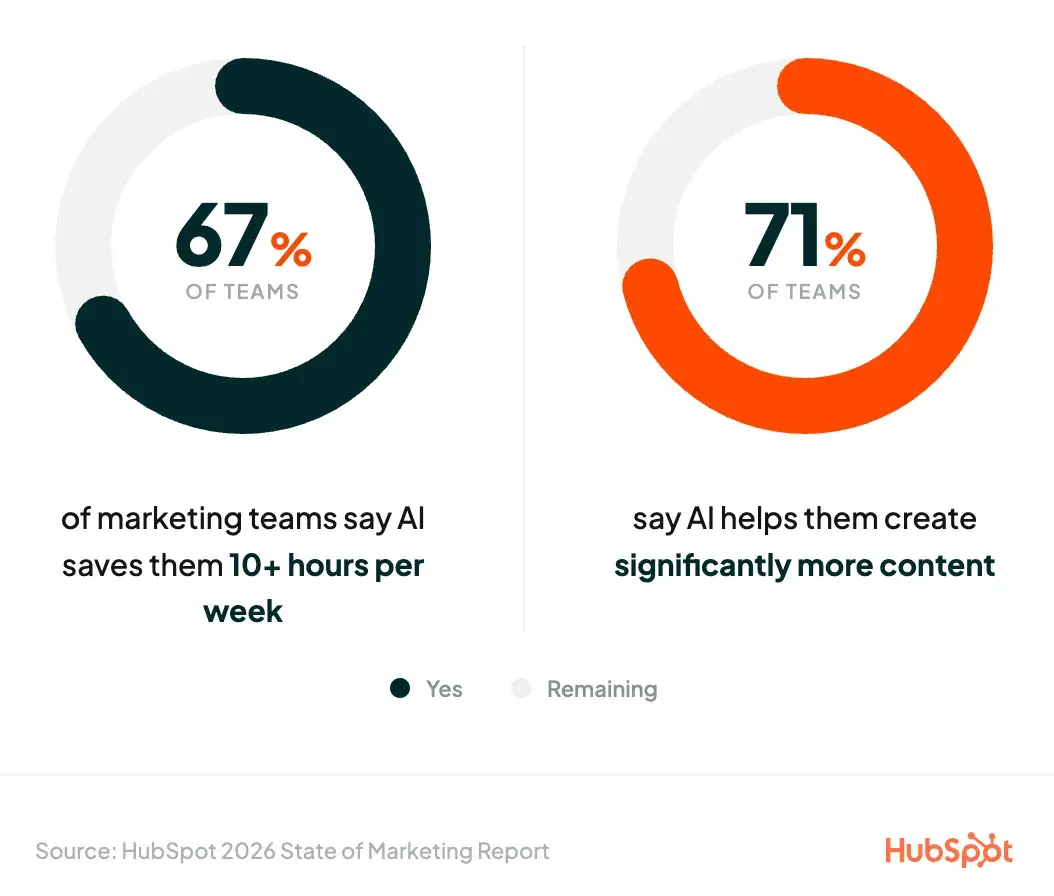
Take content marketing as an example: Small, strategically focused teams can use AI as a force multiplier, offloading the routine aspects of production so human editors can focus on narrative flow, brand voice, and accuracy. According to HubSpot’s 2026 State of Marketing report, 67% of marketing teams say AI saves them 10 or more hours per week, and 71% say AI helps them create significantly more content.
Since AI can handle much of the mundane day-to-day of a role, it frees up time for higher-order work: strategic thinking, creative problem-solving, cross-functional leadership, and long-term planning. Execution of basic tasks is becoming less valuable. And when you’re not bottlenecked by it, managers give you more challenging and visible work.
AI use is becoming the new baseline.
A generation ago, knowing how to use Excel was a differentiator. Then, it became the floor. That same shift is happening with AI right now, which means the window to get ahead is closing.
Right now, AI proficiency is still impressive. If you tell your manager you used AI to cut a process in half, or built a prompt that saves your team three hours a week, that gets noticed (more on this later).
However, what earns you recognition from your manager today will sound a lot like “I made a new macro in Excel” a year or two from now. Useful, but not noteworthy.
When AI proficiency becomes the baseline, the advantage goes to the people who got there early and built on it while everyone else was still figuring out where to start. You could even argue it is the baseline: HubSpot research found that 83% of marketers say they are expected to produce more than ever because of AI.
And here’s what matters most for your career: AI won’t replace you. But someone using it better might. Not some hypothetical robot or a faceless wave of automation. Someone in your industry, at your level, who decided to take it seriously before you did.
Managers notice who’s using AI (and who isn’t).
2026 Gallup data shows that 69% of leaders and 55% of managers use AI at least a few times a year, compared to just 40% of ICs. Your manager likely uses AI more than you do, so they have a pretty good sense of what’s possible and whether you’re keeping up.
I’m not saying your boss is keeping a secret scorecard of who prompts Claude the most. But when two people on the same team deliver similar work, and one of them consistently does it faster and more thoroughly because they’ve integrated AI into their process, that’s noted. It influences who gets the next stretch assignment, who gets brought into the strategy conversation, and who’s promoted.
Why is AI so hard to adopt?
There’s a reason so many people get stuck between “I know I should be using AI more” and really doing it. Actually, there are several well-documented reasons:
The Knowing-Doing Gap
We’ve all wanted to learn or try something new, only to realize that months or years have gone by without actually doing anything about it. Just ask my bass guitar gathering dust in my bedroom.
Researchers Jeffrey Pfeffer and Robert Sutton labeled this phenomenon the “knowing-doing gap”. Basically, knowing what to do and actually doing it are almost entirely separate problems.
When applying the knowing-doing gap to AI, the research lines up: BCG found that despite widespread AI implementation, 74% of companies have yet to show tangible business value from their use of AI. It also found that 70% of the challenges companies face when implementing AI stem from people- and process-related issues, compared to just 30% for technology problems and 10% for AI algorithms.
Part of the reason for the lag is just practical. You already have a job to do. Your calendar is full, your task list is long, and the abstract goal of “figure out how to use AI better” is competing with every other thing on your plate.
When I asked Timothy Biondollo, HubSpot Media’s Prompt Engineer and AI Specialist, why so many people stall between awareness and adoption, he didn’t sugarcoat:
“Awareness is passive, and adoption requires you to change how you actually work, not just add a new tab to your browser. The gap is that most people are still moving through their day task by task, in order, doing the work themselves. Enabled people have made a completely different shift. They spend their time gathering context, writing instructions, and then running ten parallel workstreams in the background while they focus on strategy and quality. That’s not a small adjustment. That’s a different operating model entirely. Nobody tells you that’s what the transition actually looks like, so people try AI a few times, don’t feel the shift, and assume it’s not for them or that the AI isn’t smart enough to do it.”
Learning AI on top of executing your existing responsibilities is a genuine constraint. Your brain has a cap on processing new information, and when that’s exceeded (which, given the pace of AI over the past few years, it almost certainly has been), adoption drops sharply, even when motivation is high.
Too Many Options, Not Enough Clarity
Let’s say you do carve out the time. Now what?
There are thousands of AI tools on the market. The landscape changes monthly. New models and features launch, and your LinkedIn feed is full of people telling you about the one tool that changed their life. You don’t know where to start, so you don’t start at all.
Even if you haven’t heard of the paradox of choice, you’ve surely experienced it. The more options we have, the less we want to choose. So we freeze, or we make a worse decision than we would have if given fewer options.
That’s exactly what’s happening right now for anyone trying to build an AI habit. What’s the chance that the tool you pick is actually the right one? Intimidating is an understatement.
The Productivity Trap
There’s also a cruel irony here that I don’t see mentioned as much as it should: If you’re not deliberate about using AI, it will create more work than it reduces.
Consider a scenario where you want to use AI to summarize a dataset as a memo. You export the sheet, put it in ChatGPT, and great, a memo comes back in 30 seconds. But now you’re reviewing the output, catching inaccuracies, re-prompting because something is off, fact-checking claims you’re not sure about, and reformatting the whole thing to hit the right tone. By the time you’re done, AI doesn’t feel like an enabler; it feels like a bottleneck.
This is a huge reason AI adoption stalls. People try it, get a generic response, and think that’s it? They conclude it’s not worth the sustained effort and go back to the old way. But the problem is the approach, not the tool. Using AI well means knowing where it genuinely saves you time and where it just shifts the work around. That distinction takes practice and separates someone who’s AI-aware from someone who’s AI-enabled.
What does AI enablement look like?
We know why AI enablement and adoption matter. The jump from knowledge to practice is where so many of us stall out, and it’s not for lack of trying.
Next, I’ll outline the strategies that have worked for my content team and me. These are practical, incremental steps that turn AI anxiety into action.
Realize you aren’t behind (yet).
Doing a search for “latest AI technology” is a great way to immediately want to close your laptop and sign off for the day.
There’s a pressure with AI that comes from the constant stream of influencers, product announcements, think pieces, and even colleagues telling you how they’re getting ahead.
But that noise is largely designed to get your attention and market to you. It’s one of the oldest tricks in the book: You’re falling behind. You can’t fall behind. Subscribe to my newsletter, so you don’t fall behind. This messaging appeals to our primal desire to be in the ingroup. It’s basically caveperson logic.
Some reality for you: According to Gallup, 49% of U.S. workers report never using AI in their role, and only 26% use it a few times per week or more. Let that sink in. In the country where most major AI companies are based, only about a quarter of workers use AI frequently.
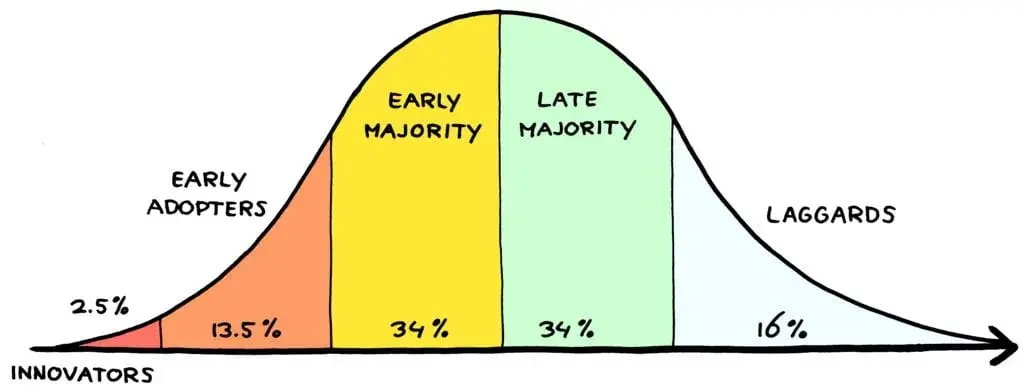
I want to introduce another concept to put things in perspective: the Diffusion of Innovation Theory. First shared by E.M. Rodgers in 1962 (and still relevant today), the Diffusion of Innovation theory divided the entire audience for a technology into five groups: innovators, early adopters, early majority, late majority, and laggards.
These groups adopt any new technology in that order. Adoption starts with the innovators (think tech enthusiasts, influencers, people first in line for the newest phone) and ends with the laggards (who still use landlines). As you can see from the diagram below, most people fall somewhere in the middle:

So, where are we on this timeline with generative AI?
It’s a subjective call, but given the data we have so far, I’d wager we’ve just entered the early majority. In other words, while AI as a concept has been in the public eye for a while now, AI proficiency is just starting to hit the mainstream. All the people you’ve heard raving about AI and its possibilities are the first 15%, the innovators and early adopters. And they’re much more vocal than the rest.
What does that mean for you? If you’re not comfortable with using AI yet, you’re still in a good spot. But don’t lag either, because the early majority is your last chance to pull ahead.
This isn’t to say that being a beginner at anything is easy — certainly not. But much of that discomfort comes from believing everyone’s ahead of you. That isn’t the case just yet.
Start small.
Like any skill, AI proficiency is a muscle that builds over time through repeated use. You don’t get stronger by reading about weightlifting. At some point, you’ll have to pick up the dumbbells.
This doesn’t mean you need to drum up an agent that summarizes all your emails, cleans your spreadsheets, manages your schedule, and does your taxes on the first go. Embrace being a beginner, look for small wins, and, just like exercise, you’ll see the benefits sooner than you think.
The first thing I ever did with AI was use it to help me suggest rewrites of my internal Slack messages if I felt like my tone was off. Basic stuff, but it became immediately clear to me how this was more efficient than stewing over the perfect way to phrase something. I saw the benefit with relatively little investment.
Eventually, I became comfortable using Claude to assist with coding internal tools for my team, generating memos from datasets, and planning out my weekly responsibilities. Now, I’d be hard-pressed to find anything I don’t use AI for in my day-to-day.
Applying AI solutions to your own problems and seeing the real-world benefits is a powerful motivator. You use it on something concrete, and it just clicks. You’ll think, “Oh, I can use it for this … what else can it do?” Your curiosity becomes the engine that builds the habit.
Plus, weaving AI into your existing work (instead of as a separate experiment or activity) clears the barrier of trying it once, getting iffy results, and returning to how you already work. You see its utility first-hand, so you’re more likely to push past the initial friction. The benefits of AI outweigh the temporary discomfort.
HubSpot Blog writer Amy Rigby has navigated this firsthand: “The hardest part about weaving AI into workflows is also the hardest part of any attempt at efficiency gains: At first, it’s going to be wildly inefficient. You’ll be stumbling over how it works, experimenting, and failing because it’s all new to you … You have to stick it out past that learning curve to unlock that value. It’s a great feeling once you do.”
Learn how to prompt.
AI prompting is the single most useful skill you can learn when starting out. A good prompt means the difference between a generic response and one that actually helps.
When I asked Meg Prater, Head of Content Strategy & Operations for HubSpot Media, why there was a gap between AI awareness and actual adoption, she said, “They’re not using the right prompts. Once you learn how to prompt better, your results make it impossible not to use AI to enhance your work and create more time to do the work that matters.”
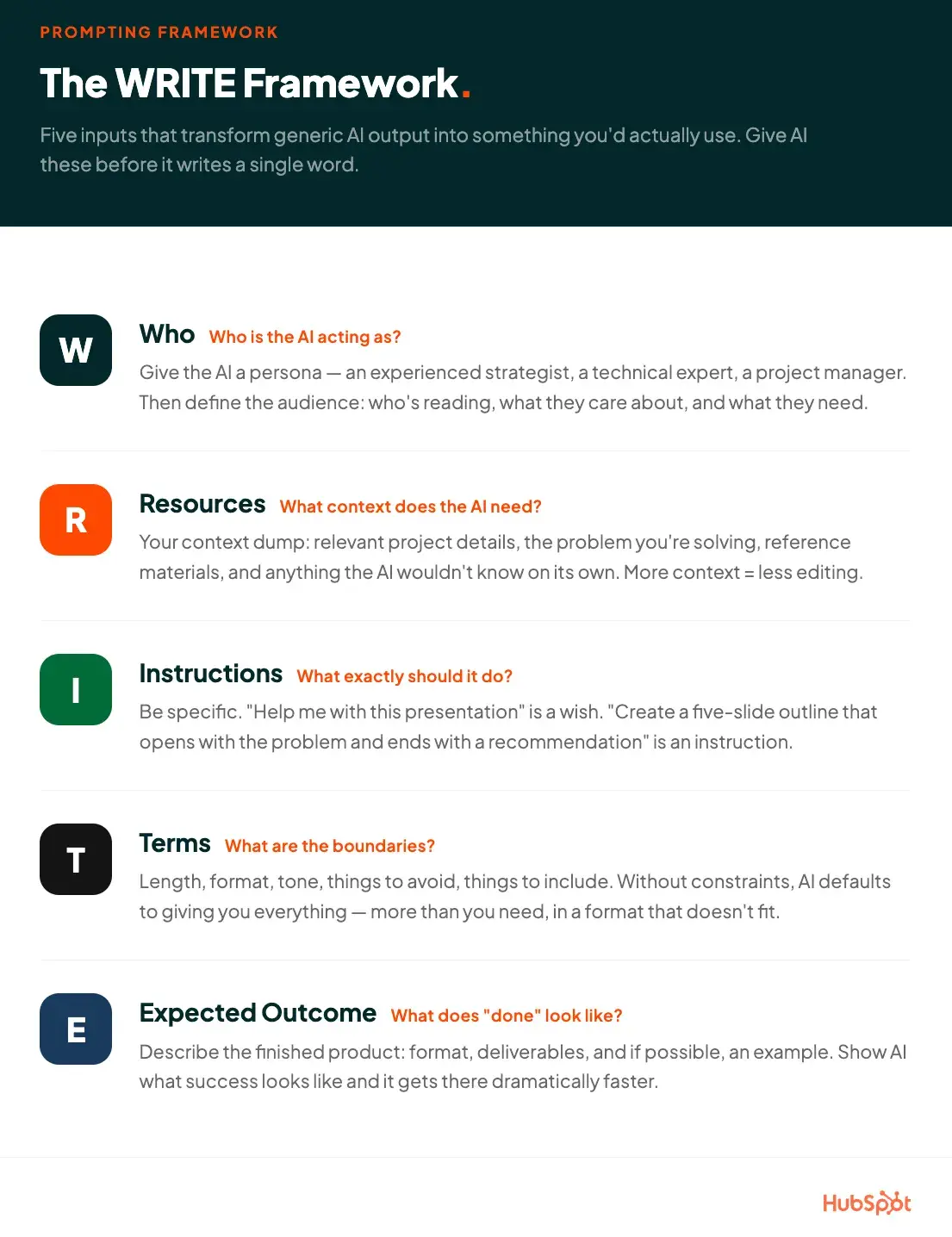
It’s okay to experiment with different prompts at first, but eventually you’ll want a framework for better-guided conversations. I encourage writers on my team to use the WRITE framework — it gives the AI five critical pieces of information for the request:
- Who: Who is the AI acting as? Give the AI a persona, like an experienced strategist, a technical expert, a project manager, etc.
- Resources: What background does the AI need to get this right? This is your context dump: relevant details about the project, the problem you’re solving, reference materials, and anything else the AI wouldn’t know on its own.
- Instructions: What exactly should the AI do? Be specific.
- Terms: What rules, limits, or boundaries apply? For example, length, format, tone, things to avoid, and things to include.
- Expected outcome: Describe the finished product as specifically as you can: the format, the deliverables, and, if possible, an example.
Here’s an example of a WRITE prompt:
W: You’re a small business marketing consultant who specializes in DTC product launches. My audience is women aged 25-40 who buy handmade candles as gifts and for self-care, mostly through my Etsy shop and Instagram.
R: I’m launching a candle summer collection in June. My budget is around $500 for the launch. My best sales channel is Instagram, and I have about 3,000 followers. My last collection sold out in two weeks, mostly through Instagram Stories and email.
I: Build me a four-week launch plan that covers teaser content, a launch day strategy, and post-launch follow-up. Include what to post, when to post it, and one email for each phase.
T: Keep the plan realistic for a one-person operation. No paid ads. Organic and email only. The tone should feel warm and personal, not corporate.
E: A week-by-week calendar I can follow, with specific content ideas for each day, three short email drafts, and a launch-day checklist.
Run this prompt next to one without a framework, and you’ll see the difference. If you’re actually a candlemaker, you’ll smell it too.
Create an AI goals schedule.
Once you’ve done some tinkering and have a sense of where AI can help you, the next step is keeping the momentum.
Easier said than done. Remember the knowing-doing gap? Research shows that having a strong goal intention isn’t enough on its own.
But, people who form plans that specify exactly how they act toward a goal are more likely to actually follow through. Thinking “I want to get better at using AI” is less effective than “Every Tuesday morning, I’ll spend 20 minutes applying AI to one task on my plate.”
So here’s what I recommend: Plan a weekly schedule of AI wins. These are tasks that you can reasonably achieve in a week. They don’t need to be major leaps. Instead, think of them as incremental progress toward a larger goal, small enough to actually complete but meaningful enough to move the needle.
A structured schedule does two things. First, it turns intention into habit, providing the scaffolding to keep you returning to it without a heroic act of willpower every time. Second, it collapses the endless possibilities of AI into practical steps specific to your work. It’s an antidote to option paralysis.
Say you want to use AI to improve your meeting efficiency and follow-up. Here’s what a schedule might look like in practice:
Primary goal: Use AI to reduce time spent on status updates and meeting prep over the next month.
- Week 1: Pick your most recurring meeting. Use AI to generate a template agenda from your notes.
- Week 2: After the meeting, use AI to draft the follow-up summary. Check if this took less time than usual.
- Week 3: Build a prompt for weekly status updates using bullet points you already keep.
- Week 4: Combine all three into a simple repeatable workflow. Run it for a week during multiple meetings.
- Week 5: Review your system. What’s working? What isn’t? What’s next? Set goals for the following month.
Nothing here is a leap. Each week builds on the last, and by week five you have a documented system.
You can track your progress however works for you: a notes app like Notion, a task management tool like Asana, a running document, or sticky notes if that’s how you roll. Consistency matters more than format.
And (you might have seen this coming), AI can even help you build the schedule itself. Explain your role and responsibilities to it, and ask it to help you brainstorm where you could realistically leverage AI in your workflow. Settle on one main SMART goal to work toward over the next four to six weeks, then use AI to draft out the sub-steps to get there.
Make your progress visible.
If your company is AI-forward, chances are your manager wants to know what you’re up to. How visible your AI progress is to them matters just as much for your career as the work itself.
This is especially true if your performance is goaled on AI adoption. Regularly telling your manager how you’re deploying AI, updating them on new use cases or efficiency gains, signals that you’re thinking ahead. That could look like a Slack message, an item in your weekly update, or a mention in your one-on-ones. Even small wins plant the idea that you’re indispensable.
Visibility is easier said than done, though: Once you get into the weeds with AI, it’s easy to get so caught up that you forget to communicate your progress. Sometimes I get so invested in a project that I forget to update my boss on how my AI use has actually improved my output.
One solution: Set a recurring calendar reminder for a manager AI update. Then, copy your adoption schedule (or whatever you’re using to track your AI progress), paste it into your AI tool of choice, and ask to summarize your weekly progress. Bam, something to share with your boss with almost no extra work.
This is why using a task management tool like Asana to track your work can be useful. You can export your completed tasks into a spreadsheet, hand it to an AI tool, and ask it to pull out the recent wins. Progress tracking is built in, and it’s much easier than keeping a separate Google Sheet you need to remember to update every time you do a thing.
I also encourage you to connect your AI use to how it’s advancing your work. Tell a narrative: how you’ve been getting better at it, and consequently, how your work has been getting better, and how that relates to team KPIs. We’re talking about advancing your career, after all.
One more note: Peer visibility matters, too. Managers are important, but so is being the person your teammates turn to when they have an AI question. That informal expert status builds upward pressure on your own advancement.
Timothy had some helpful insight here: “The trick is to share the how, not the wow. Not ‘look what I built’ but ‘here’s how I built it, maybe this helps you.’ The second it becomes useful to someone else in the room, it stops being a brag and becomes a capability unlock for the whole team.”
Keep an information loop going.
You’re doing the work, you’re showing the work, now make sure you’re staying sharp. My last piece of advice is to keep yourself learning and updated with advancements while putting your knowledge into practice.
As Meg puts it, “Someone who is AI-enabled is someone who is AI-curious. You should be experimenting with it, practicing with it, and trying out new tools/builds. It’s not enough to be running the same three prompts (though that’s a great place to start). Being AI-enabled today means you’re using and evolving with these tools and models as they’re released.”
The key is to keep an information loop that’s light enough so you don’t get overwhelmed. You want a flow that’s comprehensive enough to stay current, but not so much that you want to crawl into a hole.
Limit yourself to four or five AI information channels at a time. These could be a newsletter or blog, a YouTube channel, an internal community, a mentor, a podcast, a LinkedIn account, or even an AI counterpart, someone in a similar role who’s also experimenting.
And to make this all sustainable: Every time you add a new channel, consider dropping one.
My channels right now are:
- Simple.ai: a newsletter that presents AI news and updates in a grounded, down-to-earth way. If you want a newsletter about AI without being overwhelmed, this is it.
- Ben’s Bites: a Substack that’s a bit more ambitious in scope while still being digestible.
- An internal AI Slack channel we have at HubSpot to share AI progress relevant to marketing.
- An AI mentor.
- My team, with whom I regularly discuss how to best deploy AI on our blog.
And that’s just for now. Those might change in the future as my comfort level and responsibilities shift.
How Teams Can Move From AI Experimentation to Execution
Everything above is about enabling yourself. And for ICs, you can stop there. But if you manage a team, the move from “we’re trying this out” to “this is part of how we all work now” is a different challenge.
Driving adoption on a team is not a given. You can’t present information to someone and expect them to immediately run with it. Not everyone will be as willing or as comfortable to learn as you are. That’s not a knock on them; people have different relationships with new technology, and you might have a spread of early adopters, early/late majority, and maybe even innovators or laggards alongside you.
People generally trust other people when they’re adapting to something new. I’d bet that’s part of why you sought advice from a blog post written by me, a certified real person, over solely asking ChatGPT or Claude. There’s something about hearing “here’s what worked for me” from another human that no chatbot can fully replicate.
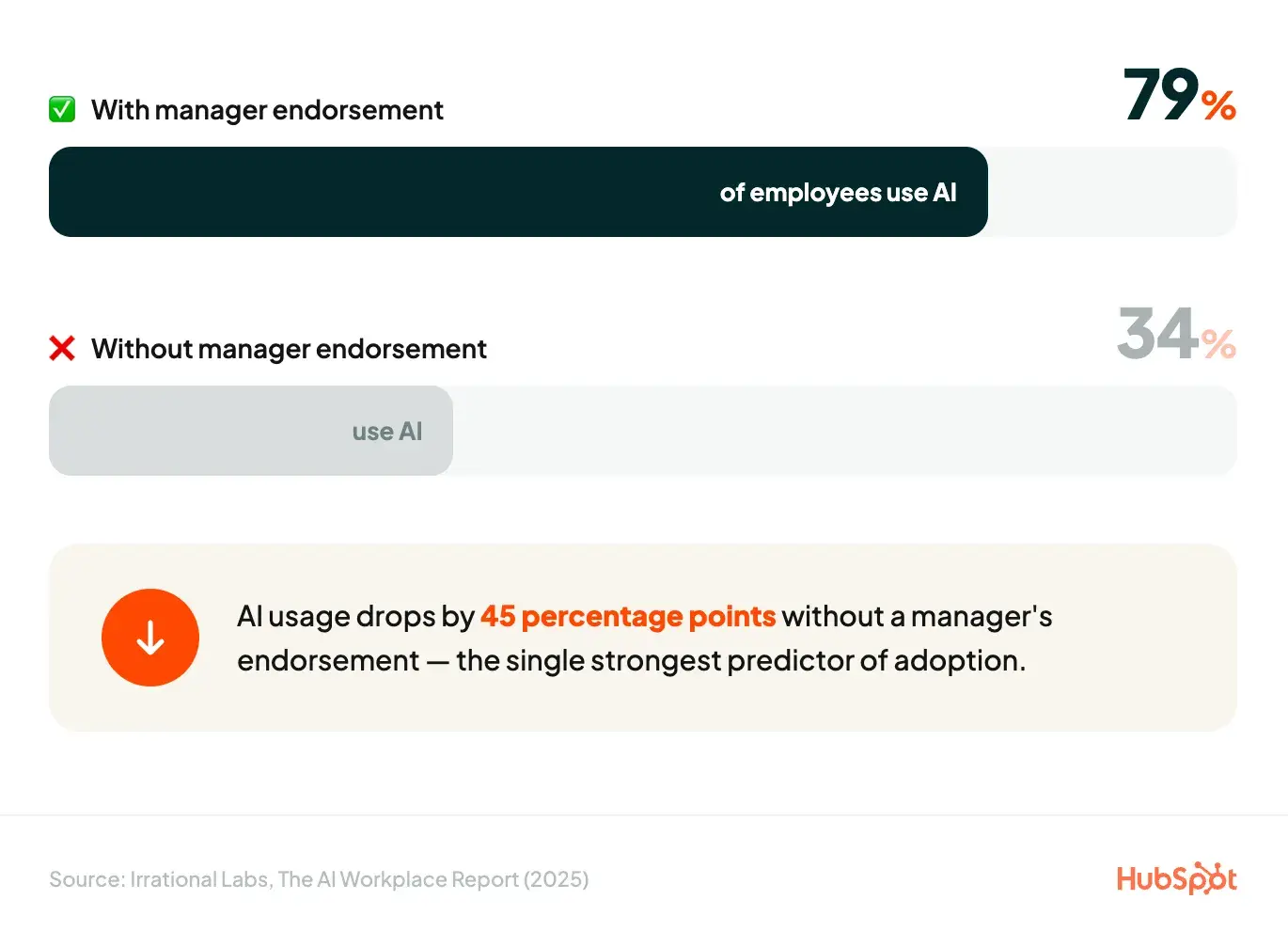
Managerial support is also among the strongest predictors of whether someone uses AI at work — according to Irrational Labs, employee AI usage drops from 79% to 34% without manager’s endorsement.
So, meet your team where they are. Ask them how they’re using AI. Not in a micromanaging, “show me your prompting history” kind of way, but from a place of genuine curiosity. What’s holding them back? Based on what you find, suggest some of the strategies I’ve introduced here.
I’ve learned more from talking with my team face-to-face than any help article or training deck could have taught me. Each individual’s AI enablement journey is their own, and the best thing you can do as a manager is encourage while giving them space to explore.
Where Futurepedia Fits Into AI Enablement
This entire post has been about one idea: knowing about AI isn’t the same as being enabled by it. And the biggest barriers aren’t problems you can solve by reading one more article or bookmarking one more tool.
That’s why HubSpot acquired Futurepedia.
Futurepedia is the world’s largest independent AI education and discovery platform. It operates the first AI tool directory — thousands of curated tools across every category you can think of — alongside a growing education platform with 25+ courses and more than 1,000 lessons focused on real-world AI skills for business and productivity.
Across Futurepedia, its YouTube channels, and its newsletter, it’s become the default starting point for professionals who want to actually learn how to use AI, not just hear about it.
HubSpot helps millions of companies grow better. Futurepedia helps professionals find and master the AI tools that make their work better. Now they’re the same team, which means more resources, bigger reach, and the same obsession with making AI work for real people.
The professionals who will win the next five years aren’t the ones who know the most about AI. They’re the ones who’ve actually learned to work with it. If this post gave you the framework, Futurepedia gives you the place to start.

from Marketing https://ift.tt/vBaW0zI
Comments
Post a Comment