Answer engine optimization (AEO) is the practice of creating content for AI like ChatGPT, Claude, and Gemini to reference in their outputs. AI-referred traffic is small but growing fast and has an outsized impact on conversions. Traffic from AEO makes up less than 1% of overall traffic but converts 3x-15x better than traditional search, according to November 2025 data from Microsoft Clarity. While the rest of the website world panics over declining traffic, savvy marketers like you are learning how to win high-intent traffic from AEO. Quality over quantity, right?
![Download Now: The State of AEO in 2026 [Free AI Search Trends Report]](https://no-cache.hubspot.com/cta/default/53/07ca2318-c9e0-4b5d-bcba-95cec5cb4958.png)
Visitors who find your site thanks to an AI answer engine are closer to buying than those who come from traditional channels. Here’s proof:
- ChatGPT referrals convert at 11.4% versus 5.3% for organic search across ecommerce sites (Similarweb 2025 research).
- Copilot’s subscription conversion rate was 15x that of traditional search and outperformed traffic from direct and social. (Microsoft Clarity study, November 2025)
- AI search use is the single strongest predictor of purchase intent for CRM software buyers. (Global HubSpot survey, January 2026)
The age of AI is a huge opportunity to sway LLMs in your favor, get them to essentially pre-qualify your leads, and send the highest-converting ones your way. And this article will be your guide.
Table of Contents
- Why AEO Visitors Demonstrate Higher Intent Than Other Traffic Sources
- How to Compare AEO Visitor Intent Against Other Channels
- How to Measure AEO Visitor Quality in Your CRM
- How to Use Intent Scoring to Quantify AEO Visitor Advantage
- Which Metrics Prove AEO Drives Higher-Intent Visitors
- How to Build a Channel Comparison Framework for AEO
- How to Start Proving AEO Visitor Quality Today
- Frequently Asked Questions About AEO Visitor Intent
Why AEO Visitors Demonstrate Higher Intent Than Other Traffic Sources
Answer engines deliver comprehensive results based on the user’s intent and with deep context, rather than just matching explicit keywords. This can basically pre-qualify your leads before any click occurs. A visitor who lands on your site has already been matched to your content as the answer, not served it as one of ten possible options.
Query Fan-out
Query fan-out condenses research by resolving several related and inherent sub-questions in a single exchange. The engine anticipates and runs the sub-searches a person would otherwise type one at a time, then returns a single synthesized answer. A buyer who once needed five queries to weigh their options gets one resolved response, which ends the back-and-forth that defined traditional research sessions.
Further Along the Customer Journey
Because answer engines handle the early research inside the chat, the visitors who click through have already cleared the definitional stage. Copilot ads for lower-funnel journeys convert 76% higher than traditional search ads, according to Microsoft Advertising. Organic search still delivers a broad mix of early-stage and navigational visitors, so the same click count carries lower average intent.
A Different Journey Than Traditional Search
When Robert Carnes ran hundreds of queries across answer engines, he found that AI isn’t replacing search so much as merging with it. Answer engines increasingly resolve the question up front and cite sources without sending the click.
Traditional search scatters the same research across many separate sessions, each with its own round of clicks. Because the answer engine has already resolved that loop, the visitors who do click arrive with most of their questions answered.
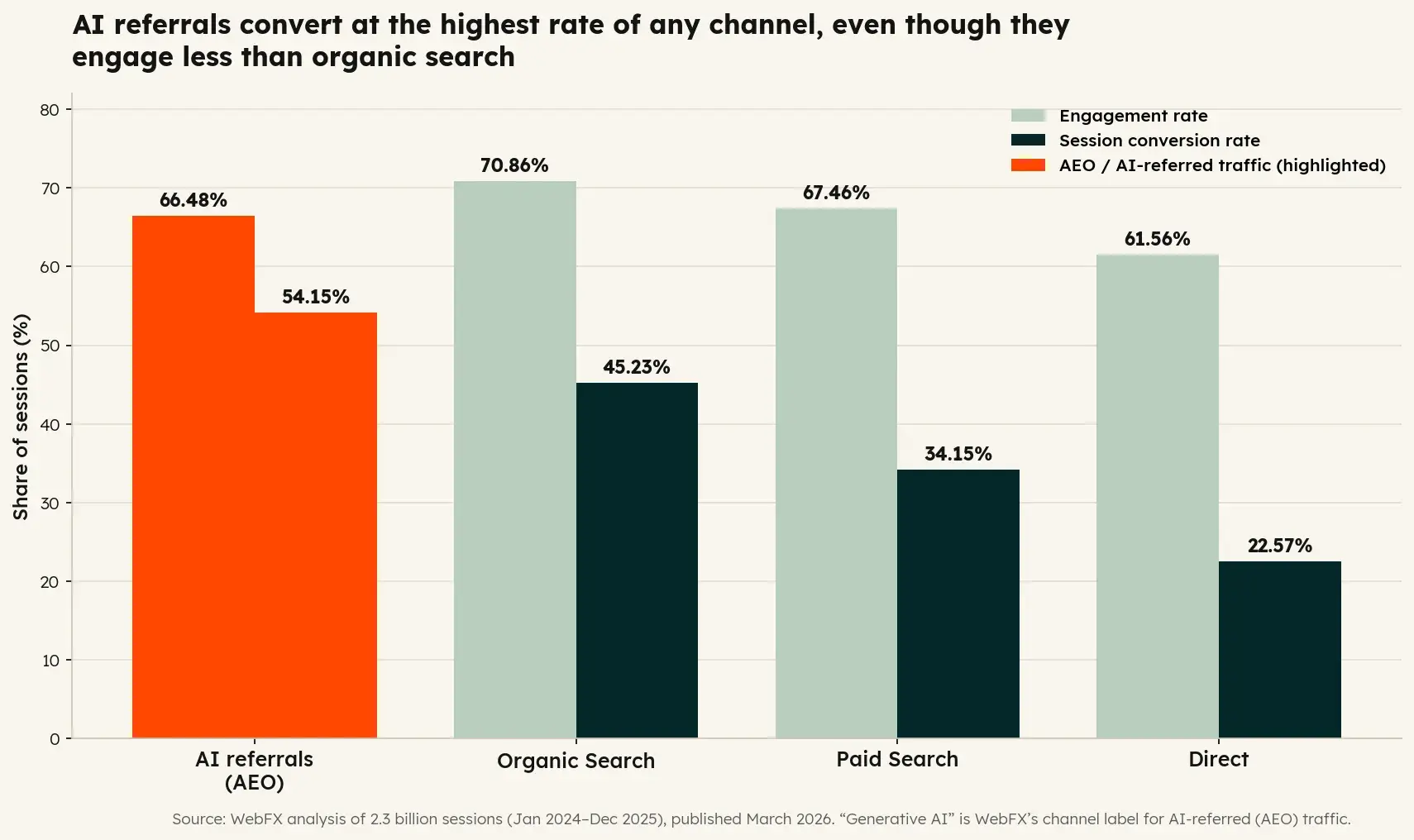
That advantage surfaces directly in your analytics. Higher-intent visitors convert at higher rates and move through the pipeline faster than paid, organic, or social traffic. A March 2026 WebFX analysis of 2.3 billion sessions found AI visitors converted roughly 1.2x higher than organic and outperformed every other free channel. The sections ahead trace each intent signal, how to benchmark it against other channels, and how to follow AEO visitors from first session to closed deal.
How to Compare AEO Visitor Intent Against Other Channels
Intent doesn’t show up as a single number. It surfaces as a pattern across engagement, source behavior, and downstream conversion, and the comparison only holds up when you measure the same signals across every channel.
Which Intent Signals Reveal AEO Visitor Quality
Four GA4 signals separate high-intent traffic from the rest:
- Average engagement time
- Engaged sessions per active user
- Views per session
- Key event completions
Read together, these intent signals show whether a visitor explored with purpose or left after one glance. Because answer engines pre-qualify visitors before the click (covered earlier), AEO traffic tends to cluster at the high end of these signals rather than the navigational low end organic search produces. Add returning-user rate and scroll depth, and the line between a buyer running a real evaluation and a drive-by visitor gets sharper.
How to Benchmark AEO Engagement vs. Organic Search, Paid, and Social Traffic
Google introduced a new AI Assistant channel in May 2026. When GA4 recognizes traffic from an AI assistant, it can assign the session an ai-assistant medium automatically, with no setup required. Early visibility may vary by property, though, so don’t assume a missing or empty AI Assistant row means you have no AEO traffic. Some AI-referred visits may still appear under Referral, Unassigned, or Direct.
Pro tip: Some answer engines show up in your source data without any configuration as [domain] / referral, as long as the referrer survives the click. ChatGPT search result clicks can be easier to identify because OpenAI says ChatGPT automatically adds utm_source=chatgpt.com to referral URLs. That UTM can preserve attribution when referral data is unreliable, assuming the parameter survives redirects and landing-page processing.
Here’s what that ChatGPT referral traffic looks like in my Google Analytics dashboard:
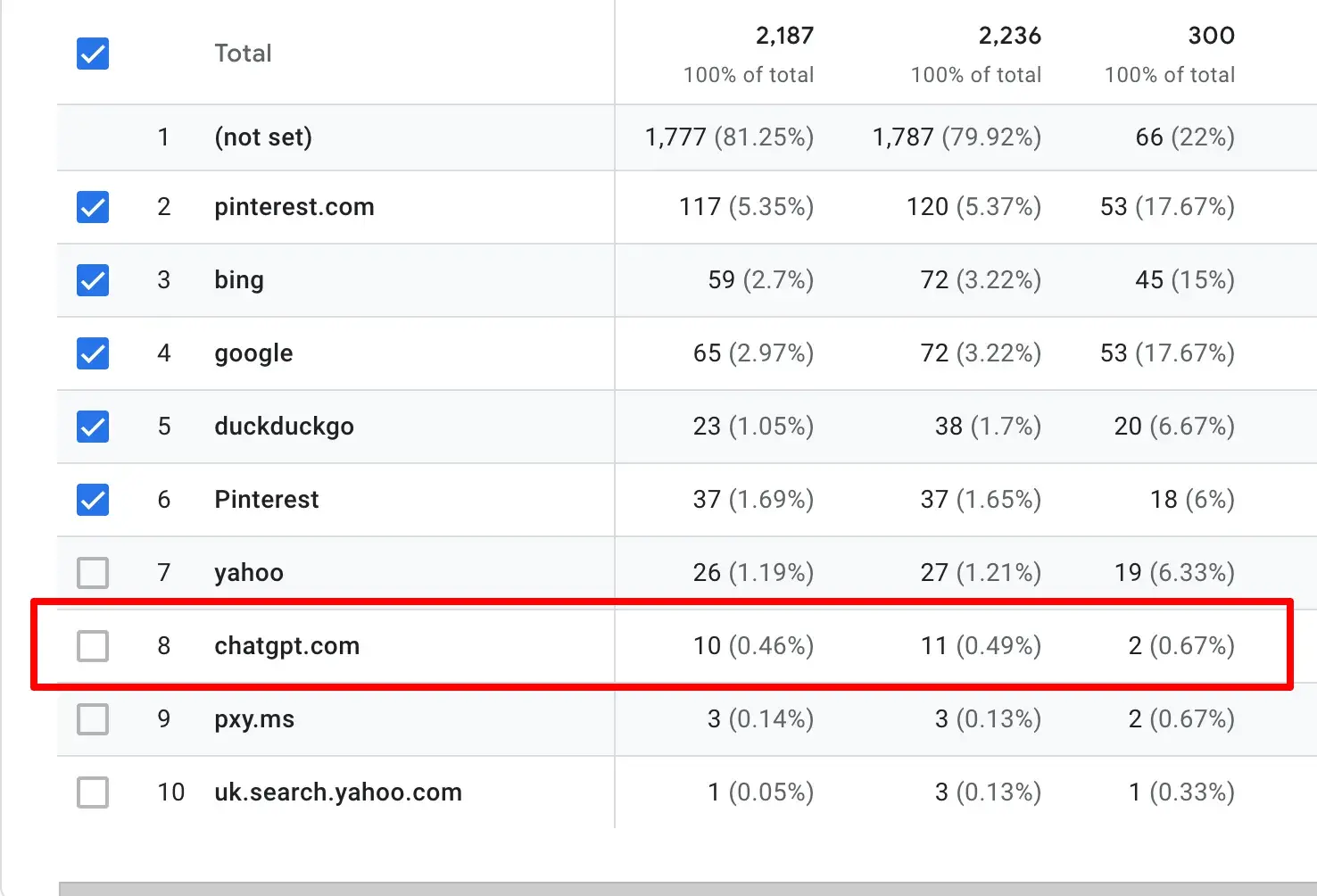
To benchmark AEO traffic against search and social, you first need to find it. Below are three ways to do that in GA4, from fastest diagnostic check to a cleaner reporting setup.
Option 1: Spot-check with Session Source / Medium.
Before you build anything, you can gauge the volume in seconds:
- Open Reports > Traffic acquisition.
- For primary dimension, select Session source / medium.
- Search chatgpt, perplexity, claude, and gemini to see roughly how much answer engine traffic you’re getting.
This quick check tells you whether there’s enough volume to justify the setup in Option 2.
Option 2: Build a custom channel group.
This is the workaround many SEOs use when the native channel is unavailable or incomplete. It’s also worth keeping after the native channel appears, because a custom regex can catch additional source patterns you see in your own data. You’ll need Editor or Administrator access to the GA4 property.
- Open Admin > Data Display > Channel Groups and click Create new channel group.
- Add a channel and name it something like “AI Search.”
- Add a condition group: set Source to matches regex, then paste a pattern covering the major answer engine domains you want to track: chatgpt\.com|chat\.openai\.com|perplexity\.ai|claude\.ai|gemini\.google\.com|copilot\.microsoft\.com|deepseek\.com|grok\.com|meta\.ai|you\.com
- Move the new channel above Referral in the list.
- Save. You can apply custom channel groups retroactively to existing GA4 data. That way, you can analyze past traffic instead of waiting for a forward-only baseline.
Option 3: Use the native AI Assistant channel (if available).
If the native channel has reached your property, it’s the lowest-maintenance option:
- Open Reports > Acquisition > Traffic acquisition.
- Set the primary dimension to Session default channel group.
- Look for the AI Assistant row beside channels like Organic Search, Paid Search, and Organic Social.
Pro tip: Any method will undercount true answer engine influence. AI visits that arrive without a referrer header, such as clicks from in-app browsers, copied links, or privacy-restricted environments, may still fall into Direct, as Search Engine Journal points out. Treat the native AI Assistant channel as a cleaner signal, not a complete count of AEO-influenced traffic.
Whichever method gets you there, the comparison runs the same way: Line AI Search or AI Assistant traffic up against Organic Search, Paid Search, and Organic Social, compare the same engagement signals across one date range, and use one primary conversion goal for the headline benchmark. Then add secondary key events by funnel stage so you don’t over-credit or under-credit channels that play different roles.
How Condensed Search Paths Translate to Higher Conversion Readiness
It may seem counterintuitive, since multiple touchpoints were traditionally seen as necessary for warming up leads. But when an answer engine resolves the research loop inside the chat through query fan-out, much of that warming happens before the visitor ever reaches your site. Fewer sessions to conversion then reads as higher readiness, not weaker engagement. The next section shows how to measure that compression directly, so you can prove it against organic, paid, and social rather than infer it.
How to Measure AEO Visitor Quality in Your CRM
Isolating the channel was step one. Turn traffic into proof with tracking in your CRM.
How to Track AEO Visitor Progression from Session to Contact to Closed Deal
GA4 can show acquisition, engagement, key events, and attribution paths, but it usually can’t prove B2B pipeline quality or closed-won revenue on its own. To connect AEO traffic to contacts, deals, and revenue, the source needs to carry into your CRM.
HubSpot Smart CRM tracks a visitor’s activity before they’re ever added as a contact. Once they convert, HubSpot associates the new contact record with that earlier anonymous activity, so the Original Traffic Source reflects their first visit rather than the session when they filled out a form. Deals inherit that attribution automatically, since the Original Traffic Source on a deal pulls from whichever associated contact has the oldest recorded activity.
HubSpot also classifies AI Referrals as a distinct traffic source. When a visitor clicks a cited link inside a ChatGPT, Claude, Perplexity, or Gemini response, HubSpot tags that session as AI Referrals with no custom configuration required.
So the thread GA4 can’t complete on its own (e.g., an answer engine visit followed to contact and then to a closed-won deal with the source preserved) runs end to end inside HubSpot whenever the visitor can be tracked and associated.
How to Use Intent Scoring to Quantify AEO Visitor Advantage
Intent scoring combines several signals into one comparable figure per session. Assign point values to the behaviors that mark a serious evaluator: clearing your median engagement time, hitting a target scroll depth, viewing a pricing or comparison page, and completing a key event. Sum the points per session, then average the score by channel.
Built this way, the score does two things a raw conversion rate can’t. It captures intent before a visitor converts, so you can judge a channel even when its volume is too low for a conversion rate to stabilize. And it holds every source to one rubric, which is what makes “AEO visitors are higher intent” an auditable claim rather than an assertion.
HubSpot AEO tracks how your brand appears across ChatGPT, Perplexity, and Gemini, which tells you whether answer engines surface the pages your highest-scoring visitors land on. Pairing that visibility view with your channel intent scores connects what answer engines cite to the quality of the traffic they send.
Which Metrics Prove AEO Drives Higher-intent Visitors
The proof already lives in your GA4 and CRM. Turning it into a case a skeptical stakeholder can’t dismiss takes two moves:
- Optimize for the metrics where AEO wins. Volume isn’t one of them. Quality is.
- Consolidate the winning metrics into one channel comparison. So the case reads at a glance instead of being scattered across five dashboards.
How to Optimize for AEO Visitor Quality, Not Just Volume
AEO sends fewer visitors than organic, paid, or social, so the play is to optimize for quality. Here are three ways to do just that:
1. Anticipate the query fan-out.
Answer engines don’t just answer the user’s question. They split it into sub-queries and resolve each one before synthesizing a response (covered earlier). Help your page show up in the citation by addressing the full fan: the original question plus every related sub-query a buyer would ask next.
- Map the sub-queries a real buyer types around your primary keyword. If you need ideas, Otterly’s free fan-out tool predicts the sub-queries AI answer engines are likely to generate.
- Cover them in one comprehensive page, not scattered across five thin posts.
- Prioritize the sub-queries that carry purchase intent: comparisons, pricing, integrations, and decision criteria.
2. Write for buyer prompts, not generic search queries.
Traditional SEO optimizes for what people type into Google. AEO optimizes for what buyers type into ChatGPT and Perplexity — usually longer, more conversational, and more decision-oriented (“best CRM for a 10-person sales team that already uses HubSpot” versus “best CRM”).
AEO in Marketing Hub uses your CRM data to suggest relevant prompts informed by your actual business context. Because it knows your industries, competitors, and customer segments, your tracking is tailored to the personas already in your funnel, rather than generic category guesses.
3. Tie every cited page back to revenue.
Content that gets cited isn’t automatically content that converts. Track each AEO-driven page all the way to closed-won, and cut the topics that pull traffic but not pipeline.
Because AEO in Marketing Hub sits right next to your CRM, you can use HubSpot’s unified reporting to connect your AI-referred traffic to the actual contacts and deals it generates.
Pro tip: Rank your cited pages by average deal amount, not by traffic volume. The lowest-traffic page producing your largest deals is the topic you should be publishing more of.
How to Demonstrate AEO ROI Through Channel Comparison Reporting
Once you’ve optimized for quality, consolidate the proof into one comparison: same date range, same key event, with every channel held to the same measure.
The three headline metrics. These carry the case to a leadership audience:
- Per-channel intent score. Your composite of engagement and conversion signals, averaged per session. Shows where AEO clusters relative to organic, paid, and social.
- Session key event rate. Share of sessions completing your primary conversion goal, by channel. This is the first place the quality gap becomes obvious.
- Deal close rate by source. Share of AEO-sourced deals reaching closed-won, pulled from Original Traffic Source on each contact and deal. This is the revenue proof GA4 alone can’t produce.
The four GA4 engagement signals that feed the intent score:
- Average engagement time per session, by channel
- Engaged sessions per active user
- Views per session
- Scroll depth and returning-user rate (the secondary read on genuine evaluation)
The two proof-past-the-session pairs:
- Days to key event + touchpoints to key event, read in attribution paths by channel. Fewer of both means visitors who arrived ready.
- Average deal amount + deal velocity by source. A channel can send fewer visitors and still produce larger deals that close faster.
Report all of it side by side: AI Search against Organic Search, Paid Search, and Organic Social on one date range and one key event.
How to Build a Channel Comparison Framework for AEO
Your comparison is only as trustworthy as the setup behind it. Three things keep the framework honest: clear ownership, shared documentation, and clean data handling.
Assign an owner to every moving part.
The fastest way to break a channel comparison is to let three teams each assume someone else owns it. Split it explicitly:
- Channel definitions → whoever owns your analytics setup. They maintain the AI Search regex from earlier and add new answer engine domains as tools emerge.
- Intent-score rubric → Analytics. They own the point values and engagement-time thresholds, and keep the scoring consistent whenever signals get re-weighted.
- The dashboard → Marketing. They own the view where AI Search sits beside organic, paid, and social, held to one date range and one key event, with conversion rate, average deal amount, close rate, and deal velocity per channel.
Document it so that three teams agree on one source.
Marketing, Analytics, and Sales will each interpret “AEO traffic” differently unless the definition lives in one place. Record:
- The exact regex pattern the AI Search channel uses.
- The intent-score point values and what each behavior is worth.
- The conversion goal every channel is held to.
Then, QA the capture path quarterly. Run through a short checklist:
- Does the AI Search channel still catch new answer engine domains?
- Do answer-engine visits still land under HubSpot’s AI Referrals source on new contacts and carry to the associated deal?
Handle privacy, consent, and data retention.
Two settings decide whether your comparison is both compliant and complete:
- Consent first. HubSpot’s consent banner lets visitors opt in or out of cookie tracking to support GDPR and CCPA compliance. Collect consent before you track anything.
- Retention window matched to your lookback. GA4 deletes user- and event-level data after the period you choose (two months by default, extendable to 14, or 50 with Google Analytics 360). Set it to reach as far back as your comparisons need to. Note: This setting affects only explorations and funnel reports, not standard reports.
One caveat worth stating plainly: Keep your legal team, not a blog post, as the authority on what your jurisdiction actually requires.
How to Start Proving AEO Visitor Quality Today
The framework keeps the comparison honest as people and tools change, but you can get a first read this week. Five steps, each one built earlier in this guide, turn scattered analytics into a defensible channel comparison.
- Define your intent signals. Name the behaviors that mark a serious evaluator: clearing your median engagement time, hitting a target scroll depth, viewing a pricing or comparison page, and completing a key event.
- Segment AEO traffic. Build the AI Search channel with the regex pattern or the native AI Assistant channel so answer engine referrals separate cleanly from organic, paid, and social.
- Compare channels. Line AI Search up beside the others on one date range and one key event, so every source answers the same question.
- Track to CRM. Let HubSpot’s Original Traffic Source property capture organic answer engine referrals automatically (its AI Referrals category), since you can’t tag the links an engine generates to your site. For links you place yourself, add UTM parameters as hidden form fields so that the source writes to the contact record too.
- Build the comparison dashboard. Consolidate per-channel intent score, session key event rate, average deal amount, close rate, and deal velocity into one stakeholder-facing report.
That sequence gives you proof from your own data. Start with a visibility read. AEO Grader gives you a baseline of how your brand is doing in terms of AI visibility. A brand that already surfaces well across answer engines is positioned to send the pre-qualified traffic this guide measures; a brand that doesn’t has a clear gap to close before the channel can perform.
Frequently Asked Questions About AEO Visitor Intent
How do I prove AEO visitors have higher intent than organic search traffic?
Compare the same engagement signals across every channel on one date range and key event: average engagement time, engaged sessions per active user, views per session, and key event completions. AEO clusters high; organic carries a broader navigational mix. To connect that intent to revenue, Marketing Hub Enterprise’s multi-touch revenue attribution credits each touchpoint to closed deals once you’ve isolated AEO as a source.
What engagement metrics best demonstrate AEO visitor quality?
Four GA4 signals do most of the work: average engagement time, engaged sessions per active user, views per session, and key event completions. Together, they show whether a visitor evaluated with purpose or bounced after one glance.
How does query fan-out improve visitor quality compared to traditional search?
Traditional search scatters research across many sessions and queries. Query fan-out runs those sub-searches inside one exchange and returns a synthesized answer, so a buyer who once needed five queries gets one resolved response. By the time they click, the definitional and comparison work is done. That compression is why visitors arrive further along the buyer journey, and why fewer sessions to conversion reads as higher readiness.
How often should I refresh my channel comparison analysis?
QA the capture path quarterly. Confirm the AI Search channel still catches new answer engine domains and that answer-engine visits still register under HubSpot’s AI Referrals source on new contacts. Refresh channel definitions whenever a new answer engine gains traction, and revisit intent-score weights if engagement patterns shift.
What if my AEO traffic volume is lower than other channels?
Lower volume is expected. AEO sends fewer visitors than mature organic or paid, so raw session count looks like a weakness, but the strength lies in the quality signals. Lean on per-channel intent score instead: It captures intent before a visitor converts and helps you gauge a channel’s effectivemess even when volume is too low for a conversion rate to stabilize. A high-score, low-volume channel is underexploited, not underperforming.

from Marketing https://ift.tt/lGzaiW8
Comments
Post a Comment